After the breakup
Do avoidants come back? What the research can and can't tell you
By Alexis Friedlander, MSc · Updated · 4 min read
Not sure what your pattern is? Take the free attachment style quiz.
You are not asking a silly question
If you are reading this, you have probably checked your phone more than once today. You are replaying the last conversation. You are trying to work out whether the silence means "never" or "not yet".
I know this from the other side. For years I was the one who went quiet.
So here is the straight version: what we know, what we don't, and what I would do in your place.
What the numbers say about getting back together
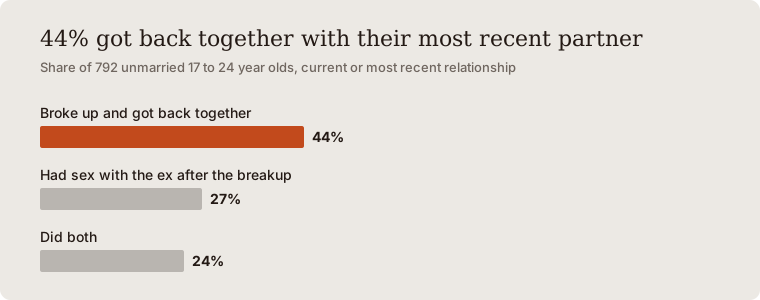
Source: Halpern-Meekin et al. (2013), 792 unmarried 17 to 24 year olds.
Researchers in Ohio asked 792 unmarried young adults about their current or most recent relationship. 44% had broken up and got back together with that partner at least once. The researchers gave it a name: relationship churning.
An earlier study of US college students found that nearly two-thirds had been in an on-again, off-again relationship at some point in their lives.
Two cautions. These are young adults, and the studies are about couples in general, not avoidants. I have not found one solid study that gives a return rate for avoidant partners. Anyone who quotes you a percentage for that is guessing.
What the numbers do tell you is simple. A breakup is often not the last chapter. Your hope is not naive.
Why avoidant partners in particular tend to circle back
Avoidant people are good at pushing feelings down. That is not an insult. It is a skill they learned early, and it works. Up to a point.
In one experiment, people were asked not to think about their partner leaving them. Dismissing-avoidant adults could do it. The thoughts became harder to reach, and their bodies stayed calmer.
A later experiment found the limit. People recalled a painful breakup and were told to push it out of mind. Then some were given a second job: hold a seven-digit number in their head. Under that extra load, the avoidant participants' defence cracked. Thoughts of separation came back, along with harsh thoughts about themselves.
Here is how I read that. Your avoidant ex may look fine after the breakup, and for a while they may feel fine. The feelings are parked, not gone. When life piles on, with stress or a bad month or a quiet flat, what was parked can come back up. These are lab studies and a lab is not a relationship. But both experiments point the same way.
Coming back is not the same as changing
This is the part nobody wants to hear, so I will say it plainly.
In the college study, people in on-again, off-again relationships reported more negative experiences than couples who had never broken up. Getting back together resets the clock. It does not reset the pattern.
So if they do reach out, look for three things:
- They can name what went wrong. In their own words, including their part in it.
- They do something different. A new sentence is cheap. A new behaviour, repeated, is evidence.
- You are different too. Calmer, clearer about what you need, and able to say it without a three-page text.
If none of the three is there, you are not getting a second chance. You are getting the same relationship again.
What to do while you wait
- Stop reading silence as a verdict. Silence tells you they are quiet. It does not tell you why.
- Don't chase with long messages. Pressure is the thing an avoidant person pulls away from. One short, calm message does more than ten anxious ones.
- Work on the part you control. In my method the first stage is Calm: getting from turmoil back to focus. You cannot read a relationship clearly while your nervous system is on fire.
- Decide what you would need to see. Write it down now, while they are away. It is much harder to stay honest once they are standing in front of you.
The question I would ask instead
"Will they come back?" keeps you looking at them. Try this one: if they came back tomorrow, exactly as they are, would it work?
If the answer is yes, your job is patience. If the answer is no, your job is not to wait. It is to work out what would have to change, and whether that change is realistic.
Master your attachment, you master your relationships.
Common questions
How long does it take an avoidant to come back?
No research gives a timeline, and I would not trust anyone who offers one. It depends on the person, how the breakup happened, and what is going on in their life.
Does going no contact make an avoidant come back?
No contact is for your recovery, not a way to move them. Space can lower the pressure they feel, but using silence as a tactic usually keeps you just as hooked.
We have broken up more than once. Is that a bad sign?
On average, on-off couples report more negatives. An average is not a verdict on you. What matters is whether anything is different this time.
Not sure what your pattern is?
Take the free attachment style quiz and see what is driving the dynamic between you.
Take the quizReferences
- Halpern-Meekin, S., Manning, W. D., Giordano, P. C., & Longmore, M. A. (2013). Relationship churning in emerging adulthood: On/off relationships and sex with an ex. Journal of Adolescent Research, 28(2), 166–188. doi.org/10.1177/0743558412464524
- Dailey, R. M., Pfiester, A., Jin, B., Beck, G., & Clark, G. (2009). On-again/off-again dating relationships: How are they different from other dating relationships? Personal Relationships, 16(1), 23–47. doi.org/10.1111/j.1475-6811.2009.01208.x
- Fraley, R. C., & Shaver, P. R. (1997). Adult attachment and the suppression of unwanted thoughts. Journal of Personality and Social Psychology, 73(5), 1080–1091. doi.org/10.1037/0022-3514.73.5.1080
- Mikulincer, M., Dolev, T., & Shaver, P. R. (2004). Attachment-related strategies during thought suppression: Ironic rebounds and vulnerable self-representations. Journal of Personality and Social Psychology, 87(6), 940–956. doi.org/10.1037/0022-3514.87.6.940
Related articles
After the breakup
Why did my avoidant ex move on so fast?
Why an avoidant ex seems to move on overnight, what research on fast new relationships shows, and what the comparison does to you.
5 min read
After the breakup
Do avoidant rebound relationships last?
Do avoidant rebound relationships last? No study has timed them. What research does show, and why waiting for it to fail keeps you stuck.
5 min read