Your side: clarity and healing
How to stop spiralling when they pull away
By Alexis Friedlander, MSc · Updated · 4 min read
Deciding whether to stay? See The Secure Decision.
This is not weakness. It is closer to withdrawal.
They have gone quiet. Your chest is tight. You have picked up your phone eleven times. You are writing a message in your head, deleting it, and writing it again.
You may be telling yourself you are "too much". You are not. Your brain is doing what brains do when someone they are attached to pulls away.
In one brain-imaging study, 15 people who had recently been rejected and were still in love looked at a photo of their ex. The parts of the brain that lit up were reward and craving areas, the same regions other studies link to cocaine craving. It is a small study, but the point stands. The pull you feel toward your phone is a craving, not a character flaw.
Why "just stop thinking about them" fails
In a famous experiment, people were told not to think of a white bear. Later, when they were free to think about anything, they thought of the bear more than people who had never been told to avoid it. Pushing a thought away makes it bounce back.
Going over and over it does not work either. A major review of the research on rumination found that it deepens low mood and makes you worse at solving problems. It feels like working on the problem, but you finish each round more upset and no clearer.
So you need a third way: neither pushing the thoughts down nor chewing on them.
Five steps for the next ten minutes
1. Breathe out longer than you breathe in. Try this: two breaths in through the nose, the second one a short top-up, then one long slow breath out through the mouth. Repeat for five minutes.
In a month-long study of 108 people, this kind of breathing, done for five minutes a day, lifted mood more than mindfulness meditation did. Anxiety dropped by a similar amount in both groups. The groups were small, around 20 to 30 people each, so treat it as promising, not proven. It costs you five minutes to test it yourself.
2. Name the feeling, out loud or on paper. "I feel scared." "I feel rejected." In a brain-imaging study of 30 adults, putting an emotion into words lowered activity in the amygdala, the brain's alarm centre. In that study people were naming emotions on faces, not their own. But it is a simple thing to try, and a short label is enough.
3. Talk to yourself by name. Instead of "why am I like this?", try using your own name: "Anna, you're scared because they've gone quiet. What do you need right now?"
It feels odd. It also works. Across seven studies with 585 people, those who used their own name, instead of "I", felt less distress under pressure, performed better, and went over it less afterwards. It gives you a step of distance, like advising a friend.
4. Give your mind one thing to hold. In the white bear experiment, one thing reduced the rebound: a single, chosen replacement thought. People told to think of a red car whenever the bear came up did better.
Pick yours in advance. A place, a song, a task for your hands. Not five things. One.
5. Write an if-then plan for the urge to text. "If I want to text them, then I will put my phone in the other room and walk for ten minutes."
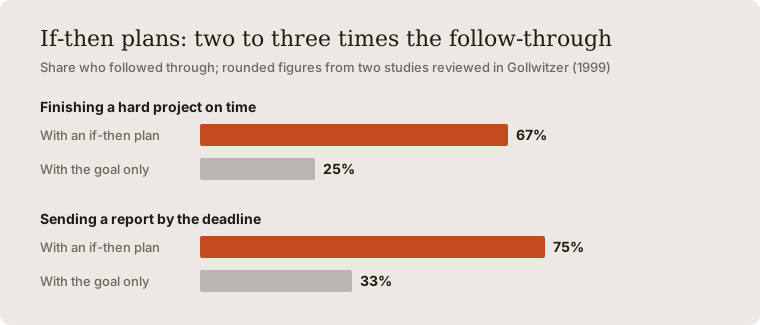
Rounded figures from two studies reviewed in Gollwitzer (1999).
These are called implementation intentions. In the studies behind this chart, people who made a plan in this form followed through far more often than people who only set a goal. "I won't text" is a goal. "If I want to text, then I will do this" is a plan.
Calm is the first stage, not the whole job
None of this fixes the relationship, and it is not meant to.
In my method, Calm comes first for a reason. You cannot judge a relationship from inside a spiral. Everything looks like an emergency, and every option looks like the wrong one.
Once your body has settled, you can ask better questions. Is this a pattern or a one-off? What have I asked for, clearly? What did they do with it?
Elise, 56, a consultant, had a long message drafted to the man she was seeing after three days of silence. Four paragraphs, every point numbered. She did the breathing first, mostly to prove to me it would not help. Twenty minutes later she deleted the draft and sent one line asking when he was free to talk. Same facts, same silence, a different message. Composite example; details changed.
Master your attachment, you master your relationships.
Common questions
Should I text them to calm myself down?
If you are texting to get relief, wait. A message sent from panic usually asks them to manage your feelings, and an avoidant person tends to step back from that. Calm first, then decide whether there is something to say.
How long does a spiral last?
It varies from person to person. What you can control is whether you feed it. Checking their profile, rereading old messages and drafting texts all feed it.
Why do I spiral more with this person than with anyone else?
An on-off, hot-and-cold dynamic keeps your alarm system switched on. It may say more about the pattern between you than about you.
Ready to decide from evidence, not hope?
The Secure Decision teaches the process Alexis uses to tell real change from another cycle.
Explore The Secure DecisionReferences
- Fisher, H. E., Brown, L. L., Aron, A., Strong, G., & Mashek, D. (2010). Reward, addiction, and emotion regulation systems associated with rejection in love. Journal of Neurophysiology, 104(1), 51–60.
- Wegner, D. M., Schneider, D. J., Carter, S. R., & White, T. L. (1987). Paradoxical effects of thought suppression. Journal of Personality and Social Psychology, 53(1), 5–13.
- Nolen-Hoeksema, S., Wisco, B. E., & Lyubomirsky, S. (2008). Rethinking rumination. Perspectives on Psychological Science, 3(5), 400–424.
- Balban, M. Y., Neri, E., Kogon, M. M., Weed, L., Nouriani, B., Jo, B., Holl, G., Zeitzer, J. M., Spiegel, D., & Huberman, A. D. (2023). Brief structured respiration practices enhance mood and reduce physiological arousal. Cell Reports Medicine, 4(1), 100895. doi.org/10.1016/j.xcrm.2022.100895
- Lieberman, M. D., Eisenberger, N. I., Crockett, M. J., Tom, S. M., Pfeifer, J. H., & Way, B. M. (2007). Putting feelings into words: Affect labeling disrupts amygdala activity in response to affective stimuli. Psychological Science, 18(5), 421–428. doi.org/10.1111/j.1467-9280.2007.01916.x
- Kross, E., Bruehlman-Senecal, E., Park, J., Burson, A., Dougherty, A., Shablack, H., Bremner, R., Moser, J., & Ayduk, O. (2014). Self-talk as a regulatory mechanism: How you do it matters. Journal of Personality and Social Psychology, 106(2), 304–324. doi.org/10.1037/a0035173
- Gollwitzer, P. M. (1999). Implementation intentions: Strong effects of simple plans. American Psychologist, 54(7), 493–503.