After the breakup
The accident that made Frida Kahlo, and what it can teach you about your breakup
By Alexis Friedlander, MSc · Updated · 5 min read
Not sure what your pattern is? Take the free attachment style quiz.
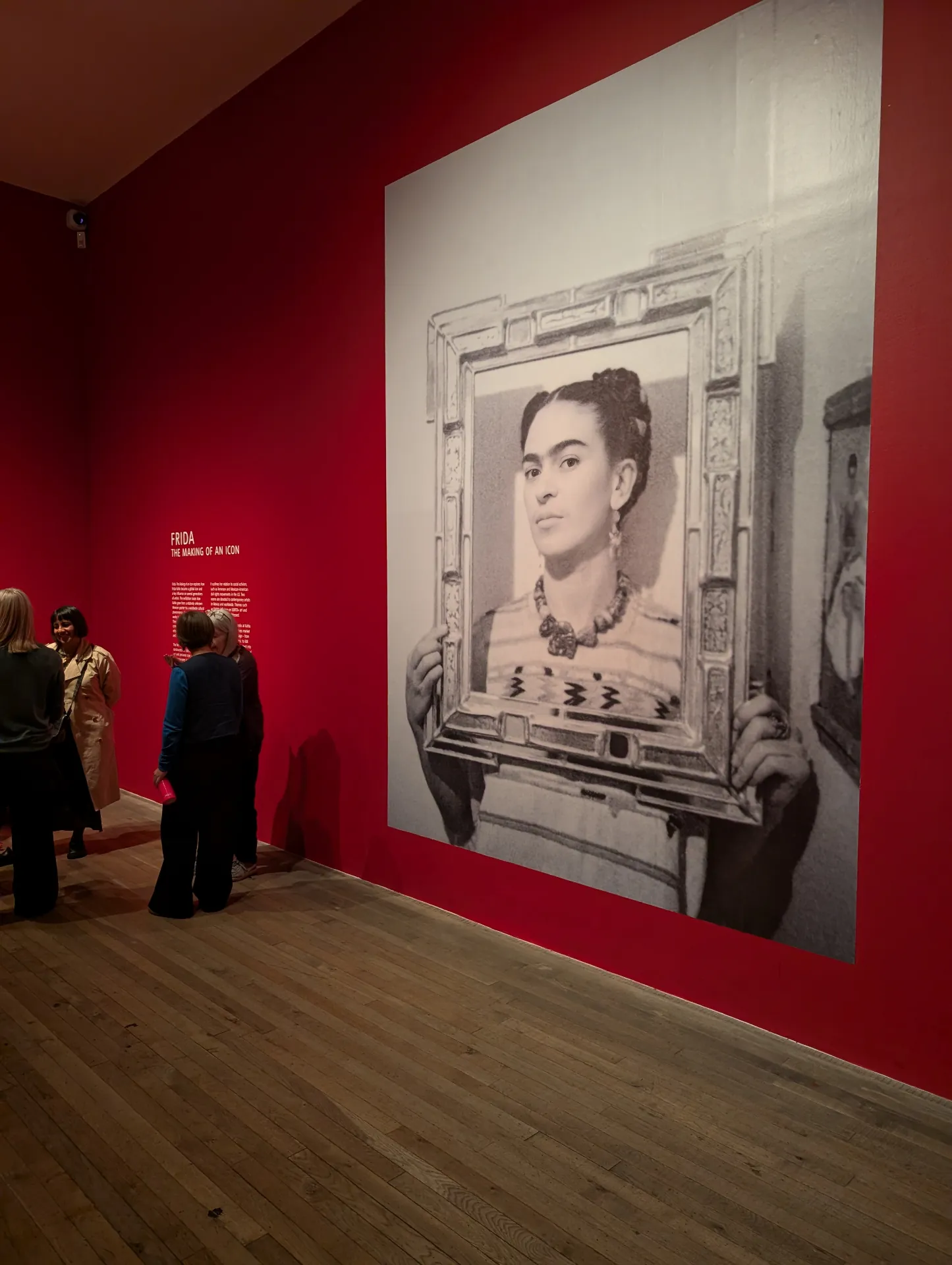
I went to the Frida Kahlo exhibition in London this week, and I stood in front of this self-portrait for a long time. A necklace of thorns cutting into her neck, and her face completely calm.
It made me think about you, and about breakups. Let me explain.
The bus
On 17 September 1925, an eighteen-year-old medical student got on a bus in Mexico City. She was bright, ambitious, one of the few girls admitted to the best school in the country. She was going to be a doctor.
A few minutes later a tram ploughed into the bus. A steel handrail went through her body. Her spine was broken in three places, her pelvis shattered, her right leg fractured in eleven. Nobody expected her to live.
She did. And she spent the following months flat on her back in a full body cast, in pain, bored, and watching the life she had planned disappear.
Her mother had a special easel made so she could paint lying down. Her father lent her his oils. A mirror was fixed above the bed, so the only model available was herself.
That is how Frida Kahlo became a painter.
The life she lost, and the one she got
It is tempting to tell this as a neat story: pain in, genius out. It wasn't neat. She had more than thirty operations. She lived in pain for the rest of her life. She could not carry a pregnancy to term. If you had asked her at nineteen whether the accident was a gift, I doubt the answer would have been polite.
And yet. Without that bus there is no easel over the bed, no mirror, no self-portraits. There is very probably a Dr Kahlo whom none of us has ever heard of. Roughly a third of her paintings are of herself, and almost all of her work is about what that day did to her body and her life. The thing that broke her became her subject.
She could not see that from the hospital bed. Nobody can. From inside the cast, it was only loss.
Your breakup is the bus
If you are reading this in the weeks after a breakup, you are in the body cast.
You had a plan too. A person, a future, a version of your life that made sense. Then something hit it at full speed, and now you are lying there replaying it, checking your phone, wondering what you did wrong and whether they will come back.
When someone tells you "one day you'll be grateful for this", you want to throw something at them. Fair enough. Frida would have.
But here is what I have seen again and again in my work. The people who do the deepest change in how they love almost never start from a good place. They start from the floor. The breakup that flattened them is the first time they stop asking "how do I get them back?" and start asking "why do I keep ending up here?"
That second question is the easel.
The pain did not make her. The mirror did.
This part matters, because the lesson is easy to get wrong.
Plenty of people were badly hurt in 1925 and did not become Frida Kahlo. The accident didn't paint anything. What changed her life was what she did while she was stuck: she looked in the mirror, every day, and painted what she actually saw. Not a flattering version. The real one.
A breakup works the same way. Pain alone doesn't transform anyone. You can spend two years in pain and come out exactly the same, ready to choose the same kind of person and run the same pattern. I see that all the time.
What transforms you is using the stillness. For once, you are not busy managing someone else's distance, decoding their texts, or shrinking your needs so they won't pull away. The relationship that took all your attention is gone, and the only model left in the room is you.
So look. Why did their silence feel like an emergency? Why did you work so hard for so little? Where did you learn that love is something you earn by chasing it?
Those are not comfortable portraits. They are the ones worth painting.
She called him her second accident
There is a line Frida is famous for. She said she had suffered two great accidents in her life: one was the tram, the other was Diego Rivera. And Diego, she said, was by far the worse.
They married, he cheated constantly (including with her sister), they divorced, they remarried. She chased, he withdrew. If that dynamic sounds familiar, it should.
Some of her greatest paintings came straight out of that heartbreak. The self-portrait at the top of this page is one of them: she painted it in 1940, the year after their divorce. But I don't offer it as a happy ending. She turned the pain of the bus into a new life. With Diego, she kept getting back on the same bus. She made art from the wound without ever quite changing the pattern that caused it.
You can do better than that. You don't need to turn your breakup into a masterpiece. You just need to let it be the last time it happens this way.
What this one could define
I am not going to tell you your breakup is a blessing. It hurts, and it is allowed to hurt.
What I will tell you is that the most painful chapters are usually the ones that end up defining us, and we never know it while we are in them. Years from now, there is a real chance you will look back at this exact period and say: that is when everything changed. That is when I stopped chasing. That is when I learned what secure actually feels like.
Frida couldn't choose the accident. She could only choose what to do in the bed.
So can you.
Master your attachment, you master your relationships.
Not sure what your pattern is?
Take the free attachment style quiz and see what is driving the dynamic between you.
Take the quizRelated articles
After the breakup
Do avoidants come back? What the research can and can't tell you
Avoidant partners often do come back, but a return is not the same as change. What the research shows, and the better question to ask.
4 min read
After the breakup
Why did my avoidant ex move on so fast?
Why an avoidant ex seems to move on overnight, what research on fast new relationships shows, and what the comparison does to you.
5 min read
After the breakup
Do avoidant rebound relationships last?
Do avoidant rebound relationships last? No study has timed them. What research does show, and why waiting for it to fail keeps you stuck.
5 min read