Talking to an avoidant
How to raise a problem with an avoidant partner without triggering a shutdown
By Alexis Friedlander, MSc · Updated · 4 min read
Want a direct read on your situation? See the Diagnostic.
Why it keeps going wrong
You bring something up. They go flat, change the subject or leave the room. You push harder because now you feel ignored. They pull back further.
Researchers have filmed this for decades. It is called demand/withdraw: one partner presses for change, the other retreats. In a classic study, who pushed and who withdrew depended partly on whose issue was on the table. The one who wants the change pushes. The one being asked to change pulls away.
Now add attachment. If you lean anxious, silence feels like danger, so you push. If they lean avoidant, pressure feels like danger, so they retreat. Each of you is setting off the other's alarm.
I spent years on the retreating side of that conversation. From the inside, it does not feel like "I don't care". It feels like "I am about to be told I'm failing, and I need to get out."
What actually works, according to the cameras
In a 2013 study, researchers filmed 180 couples. In each one, a partner raised something they wanted the other to change.
The more avoidant the person being asked, the more anger and withdrawal they showed. No surprise there.
The useful finding was this. When the partner raising the issue softened their approach, the avoidant person's anger and withdrawal dropped. Softening meant two things:
- Respecting their autonomy. Making clear that they have a say and are not being cornered.
- Showing they are valued. Making clear that the complaint is about one thing, not about them as a person.
Softening is not the same as going quiet about your needs. The partners in the study still asked for change. They changed how they asked.
Five steps for the conversation
- Choose the moment. Not mid-argument, not by text at midnight, not as they walk in the door. Ask first: "Can we talk about something for ten minutes tonight?"
- Open with what is good. "I like how we've been lately, and I want to keep it that way." This is true, and it tells their alarm system this is not an attack.
- Name one thing, and keep it short. "When plans change at the last minute, I feel unimportant." One issue. Three sentences at most. No history lesson.
- Hand them some control. "I'm not asking you to fix it right now. I'd like to know what you think." Or: "Take a day if you need it."
- Ask for one specific thing. "Could you tell me by lunchtime if the evening is off?" A clear request is easier to say yes to than "I need you to be more present."
Then stop talking. The silence that follows is them thinking. Let it be.
When they are the one struggling
There is a second finding worth knowing, because it runs against instinct.
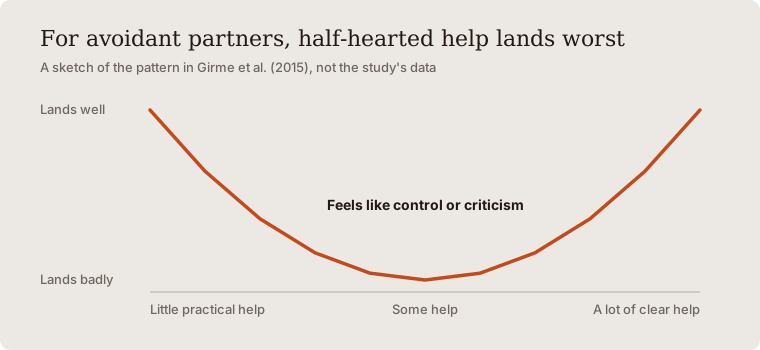
A sketch of the pattern reported by Girme et al. (2015), not the study's data.
Across four studies, researchers looked at what happens when you give practical support to a highly avoidant partner. A little help, or some help, went with worse reactions: more distress, more feeling controlled or criticised, more distance. But when the help was strong and clear, the pattern reversed and they responded well.
So with an avoidant partner, hints and half-offers can land worse than nothing. If you are going to step in, do it plainly. "I've booked the car in for Thursday, you don't need to do anything." Then leave it alone.
What to avoid
- "We need to talk." With no topic and no time limit, it sounds like a trial.
- "You always" and "you never". They will argue with the word and miss the point.
- Stacking issues. By the third one, they have left the conversation, even if they are still in the chair.
- Following them when they step away. Agree a time to come back to it instead.
If they shut down anyway
Some will, even when you do all of this well. That is not proof you said it wrong.
One shutdown tells you little. A pattern tells you a lot. If you have raised something calmly several times and nothing moves, that is evidence about the relationship. In my method this is the Expose stage: you stop analysing, act, and watch what the other person really does.
Master your attachment, you master your relationships.
Common questions
Should I raise it by text or in person?
In person or on a call for anything that matters. Text is fine for asking when to talk. It is poor for the talk itself, because neither of you can hear tone.
What if they say "I don't know" to everything?
Often that is true in the moment. Offer time: "Think about it and tell me tomorrow." Then do come back to it tomorrow.
Am I just walking on eggshells?
No. Eggshells means hiding what you need. This is saying what you need in a way that can be heard. If only one of you ever adapts, that is a separate problem, and a real one.
Want a direct read on your situation?
Bring your situation to one private session and get Alexis's perspective on where things stand.
Explore the DiagnosticReferences
- Overall, N. C., Simpson, J. A., & Struthers, H. (2013). Buffering attachment-related avoidance: Softening emotional and behavioral defenses during conflict discussions. Journal of Personality and Social Psychology, 104(5), 854–871. doi.org/10.1037/a0031798
- Girme, Y. U., Overall, N. C., Simpson, J. A., & Fletcher, G. J. O. (2015). "All or nothing": Attachment avoidance and the curvilinear effects of partner support. Journal of Personality and Social Psychology, 108(3), 450–475. doi.org/10.1037/a0038866
- Christensen, A., & Heavey, C. L. (1990). Gender and social structure in the demand/withdraw pattern of marital conflict. Journal of Personality and Social Psychology, 59(1), 73–81.
Related articles
Talking to an avoidant
How to respond when an avoidant reaches out
An avoidant ex has texted after weeks of silence. How to reply depending on what you want, with example messages and what to watch for.
5 min read
Talking to an avoidant
How to state a need without triggering a shutdown
How to state a need to an avoidant partner: why hints fail, why one clear request works better over time, and what their answer tells you.
5 min read